
Opel Insignia: Description and Operation
REAR SUSPENSION DESCRIPTION AND OPERATION
The rear suspension system on this vehicle is of the independent link type. Rear suspension adjustment is achieved through adjustable toe links and lower control arms. The rear coil springs are retained between the body and the lower control arm. Rubber insulators isolate the coil spring at both top and bottom. The rear suspension consists of 2 shock absorbers attached to the lower control arm and the reinforced body areas.
The rear suspension system performs the following functions:
- Maintains the relationship of the rear axle to the body
- Controls the torque reaction on acceleration and braking
The suspension system consists of the following components:
- Support assembly
- Coil springs and insulators
- Stabilizer shaft, insulators and stabilizer links
- Toe adjust links
- Upper lateral links
- Lower control arms
- Trailing arms
- Knuckles
- Wheel bearing/hub
- Shock absorbers
SPECIAL TOOLS AND EQUIPMENT
SPECIAL TOOLS
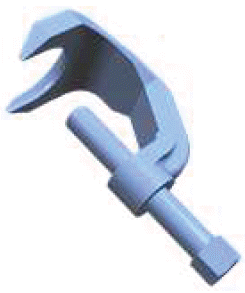
CH-43631
J-43631
Ball Joint Remover
READ NEXT:
 Suspension General Diagnosis
SPECIFICATIONS
TRIM HEIGHT SPECIFICATIONS
Trim Height Specifications (P-R Height) - Hatchback
NOTE: For 0% option vehicles add 1 mm to front and rear suspension
values.
For 100% option vehicles subt
Tire Pressure Monitoring System
SPECIFICATIONS
FASTENER SPECIFICATIONS
Reusable Threaded Fastener Tightening Specifications
NOTE:
All fasteners listed in this table can be reused after removal.
Diagnostic Information and Procedures
DTC C0569
Diagnostic Instructions
Perform the Diagnostic System Check - Vehicle prior to using this
diagnostic procedure.
Review Strategy Based Diagnosis for an overview of the diagnostic
appro
SEE MORE:
Repair Instructions
Forward Range Radar Module Inspection
Inspection Procedure
1.
CONTROL MODULE DTC CHECK - Using a scan tool, perform the Vehicle DTC
Information function - Verify there are no current control module DTCs set. If
any DTC is set, refer to Diagnostic Trouble Code (DTC) List - Vehicle.
2. Check the al
Repair Instructions
Transmission Fluid Cooler Hose/Pipe Quick-Connect Fitting Disconnection and
Connection
Removal Procedure
1.
Pull the plastic cap(1) back from the quick connect fitting (2)and down along
the cooler pipe enough
to expose the transmission fluid cooler pipe fitting retainer.
2.
Using a small flat b
© 2019-2026 Copyright www.opinsb.com
